

Green Communities in Abu Dhabi: What Is the Greenest Place to Live?
Green living takes several forms in Abu Dhabi. At The Sustainable City – Yas Island, cars are kept outside the residential clusters, solar panels cover homes and parking structures, and wastewater is treated for reuse in irrigation. The community is scheduled for handover in December 2026, while the design of its homes has already received a 5 Pearl Estidama classification, the highest available under Abu Dhabi’s Pearl Villa Rating System.
Few residential developments in the capital make their environmental ambitions quite so measurable. Yet sustainability is not confined to one model. Masdar City has spent years applying passive design, renewable energy and lower-consumption building standards across an entire urban district. At Bloom Living in Zayed City, the emphasis falls more heavily on interconnected parks, walking routes and a large central lake that places outdoor space within the everyday workings of the neighbourhood.
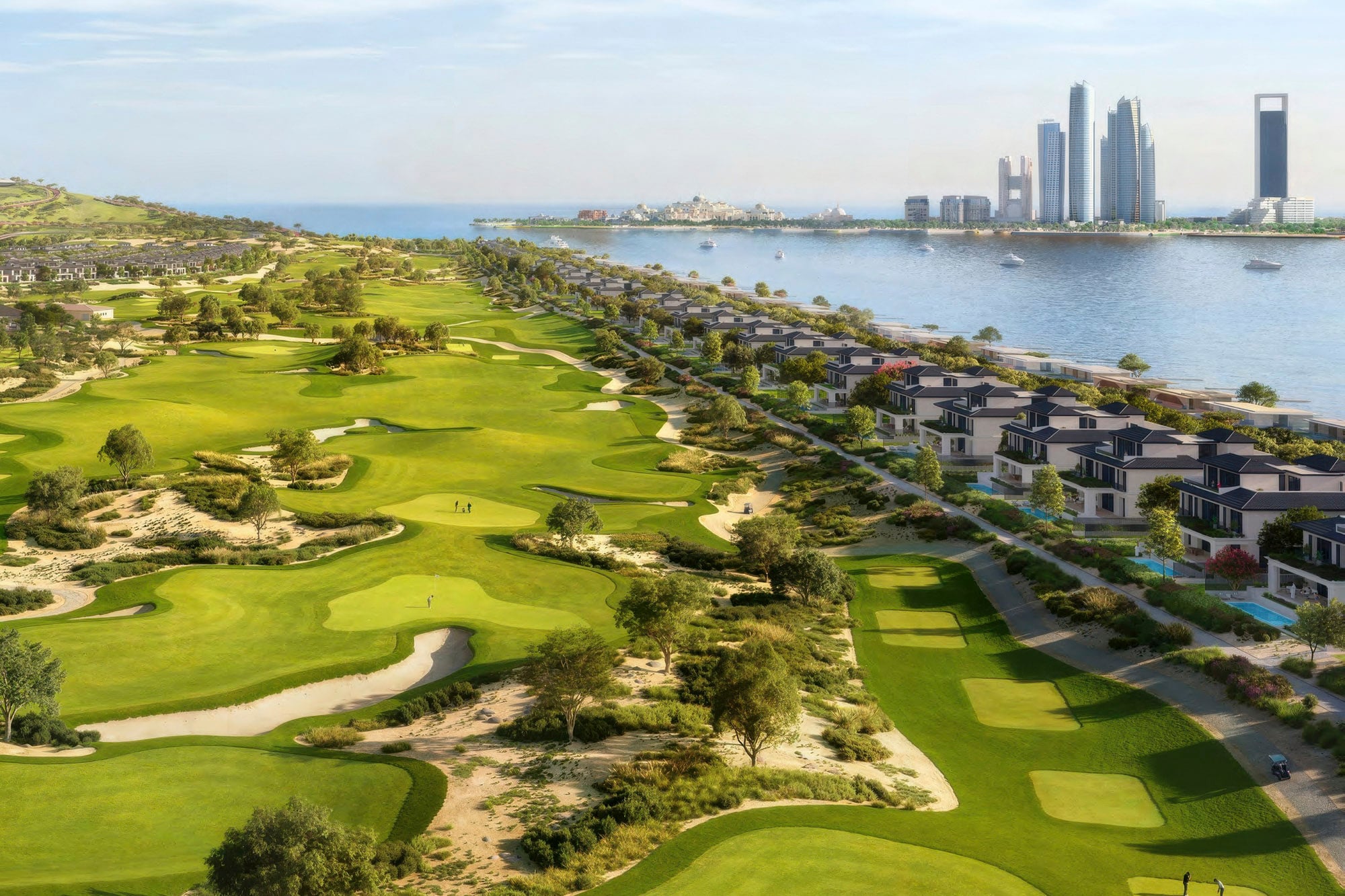
For anyone asking which is the greenest community in Abu Dhabi, the answer therefore depends partly on what is being measured. Energy, water and building performance provide one set of criteria; shade, pedestrian movement and useful green space provide another. The strongest communities increasingly bring these considerations together.
Abu Dhabi Puts a Measure on Sustainable Design
Abu Dhabi established a formal framework for sustainable building in 2010 with the introduction of the Estidama Pearl Rating System. Designed specifically for the emirate’s climate and environmental conditions, it assesses communities, buildings and villas across energy, water, materials, natural systems, liveability and other measures.
Ratings run from one to five Pearls. Privately funded new buildings must achieve at least one Pearl, while government-funded projects require a minimum of two. The higher classifications are reserved for developments that go further in reducing resource use and improving environmental performance.
Over time, those standards have produced measurable savings. By 2023, the Department of Municipalities and Transport reported that Estidama had contributed approximately 2,090 GWh of electricity savings and 14.08 million cubic metres of water savings since its introduction.
Working within these standards eventually affects rather ordinary parts of residential life: how much energy a building needs to remain comfortable, the volume of water required to maintain its gardens and whether the spaces between home, park and local amenities have been designed with the climate in mind.
The Sustainable City – Yas Island Takes the Residential Model Further
Plans for The Sustainable City – Yas Island were announced in 2022, with the residential development launched the following year. Developed by Aldar and SEE Holding, it occupies approximately 397,000 square metres in Yas North and contains 864 apartments and townhouses alongside retail and community facilities.
A significant milestone followed in 2024, when the design of its homes achieved an Estidama 5 Pearl classification. It is the highest rating available under the Pearl Villa Rating System and takes into account energy efficiency, water conservation, materials, green space, pedestrian movement and environmental quality.
The workings of the neighbourhood make those credentials easier to understand. Solar panels are incorporated into the homes and parking rooftops, while low-flow fittings are designed to consume 40 per cent less water. Waste is separated at source, with more than 85 per cent intended to be diverted from landfill, and wastewater is treated before being reused for irrigation. Smart systems reduce the water required across productive planting areas.
Cars, meanwhile, remain outside the residential clusters. The spaces within are given over to pedestrians and cyclists, with shared electric buggies and EV charging supporting movement elsewhere. A central green spine runs through the community, joined by biodomes and pocket gardens where food can be grown locally.
With handover scheduled for December 2026, The Sustainable City brings energy, water, waste, transport and planting into the same residential plan. It is this combination, rather than greenery alone, that gives the development one of the strongest formal cases for being described as Abu Dhabi’s greenest purpose-built residential community.
Masdar City Provides the Longer-Established Precedent
Long before The Sustainable City reached Yas Island, Masdar City was testing many of the same questions at urban scale. Opened in 2010, the district has developed around the principle that reducing energy use begins with the arrangement of buildings and streets rather than technology alone.
The centre is raised and orientated to capture prevailing winds, which are drawn through narrow, shaded streets. Buildings use shading and carefully considered façades to limit heat gain, while more than 11 megawatts of photovoltaic panels have been installed across the city. All new buildings are required to achieve at least a 3 Pearl Estidama rating.
Residential development follows the same approach. Eco-Residences 1 comprises 500 homes across 11 buildings and holds both LEED Platinum certification and a 3 Pearl Estidama rating. Other residences sit among offices, research institutions, shops, restaurants and public spaces, placing homes within a district planned around walking and mixed use rather than separating them from everyday services.
The parks are equally instructive. Masdar Park extends across 20 hectares and incorporates recycled materials, solar generation and measures intended to reduce water consumption. Central Park holds a 4 Pearl community rating as well as an Exemplar rating under the Estidama Public Realm Rating System.
Masdar City is therefore a rather different proposition from a self-contained housing development. Its residences belong to a wider urban project in which streets, offices, parks and infrastructure have all been used to explore lower-consumption ways of building in Abu Dhabi.
Bloom Living Makes the Park Part of the Route
Bloom Living in Zayed City approaches green community planning from another direction. Launched in 2022, the 2.2-million-square-metre development is planned to contain more than 4,500 apartments, townhouses and villas, with a series of uninterrupted parks connecting its different neighbourhoods.
At the heart of the masterplan is a large lake, around which designated trails are provided for walking, running and cycling. The parks lead between residential areas and shared facilities, while a mosque and two schools are intended to be reachable on foot or by bicycle. A clubhouse, sports facilities and the Town Centre add further destinations within the community.
The development has now moved beyond the first stages of construction. Cordoba, the opening phase, has been handed over, while the handover process for Toledo began in July 2026. Further neighbourhoods are continuing the community’s expansion across Zayed City.
Among the more useful aspects of the plan is the position of its greenery. Parks are not gathered into a single recreational corner but used to connect different parts of the neighbourhood. Walking or cycling through planted areas can therefore form part of the route to school, recreation or other local facilities.
Bloom Living does not make the same sustainability claim as The Sustainable City, nor does it have Masdar City’s long history of certified green building. Its contribution to the discussion is different: it demonstrates how a large suburban community can use open space to influence movement and the pattern of daily life.
Green Space Has to Work in Abu Dhabi’s Climate
A generous lawn or planted park does not, by itself, make a neighbourhood easy to use outdoors. In Abu Dhabi, shade, orientation and the distance between destinations are just as important.
Masdar City addresses the climate through narrow streets, building orientation and sheltered pedestrian routes. The Sustainable City removes cars from the heart of its residential clusters, leaving more room for walking and cycling. At Bloom Living, parks and pathways join neighbourhoods with schools and communal facilities.
The practical difference can be easy to overlook on a masterplan. A row of trees along a route used each evening may matter more to residents than a larger landscaped area reached only by car. A pocket garden close to home is used differently from a distant park, just as a shaded pedestrian street serves another purpose altogether.
The amount of green space remains important, but its position and accessibility determine how often it becomes part of the day.
What Is the Greenest Community in Abu Dhabi?
There is no official ranking placing every Abu Dhabi residential neighbourhood in order of environmental performance. On the available formal measures, however, The Sustainable City – Yas Island has the strongest case among purpose-built residential communities. Its 5 Pearl classification provides a clear benchmark, while solar energy, lower water use, wastewater reuse, waste separation and car-free residential clusters are built across the wider plan.
Masdar City’s importance comes from more than a decade of sustainable urban development, with certified buildings, passive architecture, renewable energy and public spaces forming part of the same district.
Bloom Living offers a further interpretation. Its strength lies in the way interconnected parks, paths and a central lake have been incorporated into a large residential community, bringing outdoor space into journeys that might otherwise depend on the car.
Whether it is the measured environmental performance of The Sustainable City, the urban planning of Masdar or the network of parks at Bloom Living, Abu Dhabi’s greener communities share one increasingly important quality. Their open spaces and sustainability measures have been planned for use rather than appearance alone, bringing energy efficiency, shade, walking and planting closer to everyday life.
Read More