

Al Ain Oasis: A UNESCO Heritage Day Trip
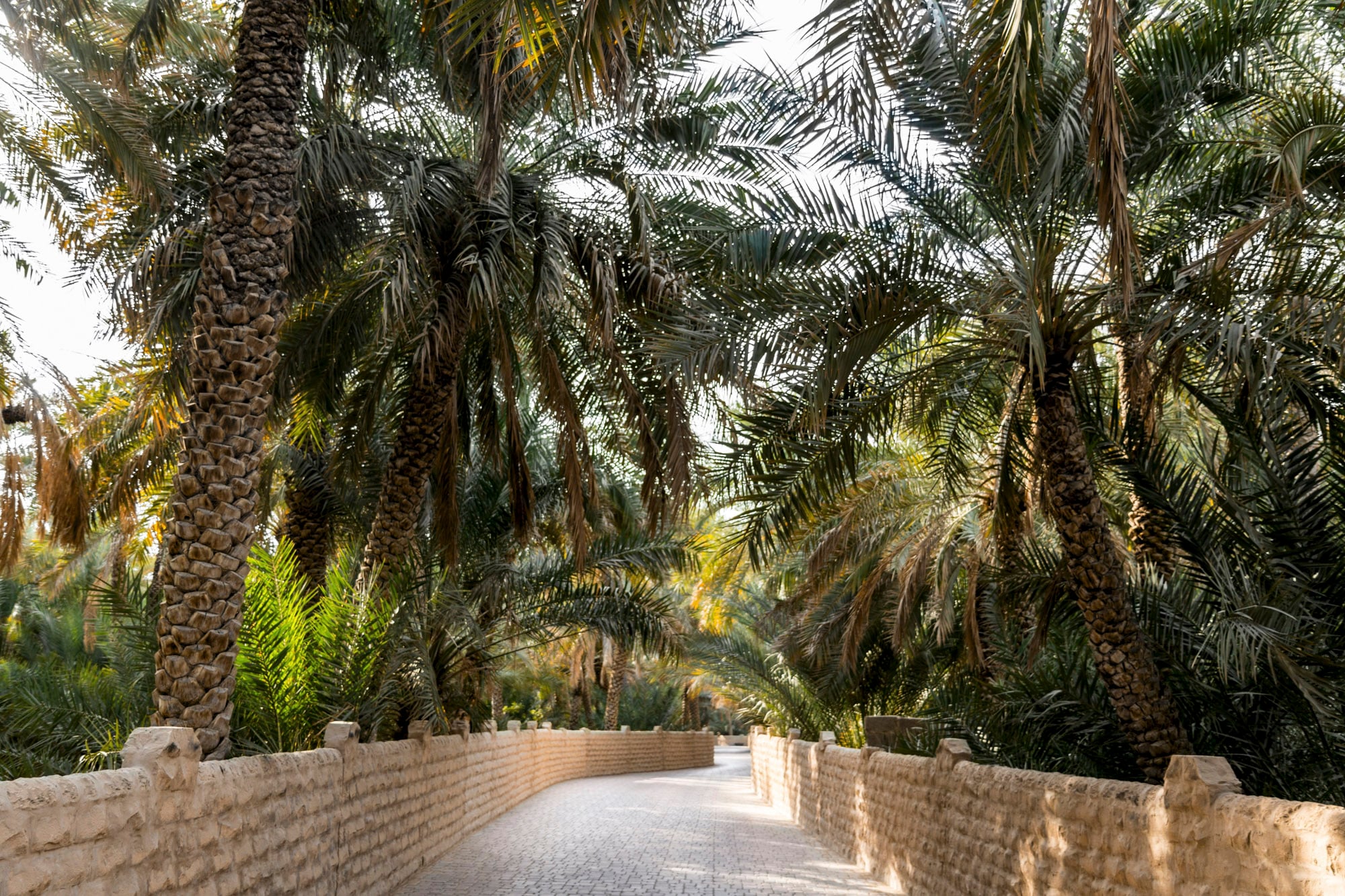
A narrow path runs between the palm gardens of Al Ain Oasis, with earthen walls on either side and a canopy of fronds overhead. Behind the walls, farmers tend plots watered by channels that have carried water through this ground for centuries, and the streets of a modern city lie only a few minutes’ walk away.
Al Ain has been settled for more than 4,000 years, and its oases were the reason. The largest of the six historic oases in the city, Al Ain Oasis became part of the Cultural Sites of Al Ain when UNESCO inscribed them on the World Heritage List on 27 June 2011, the first such inscription in the UAE. On 3 November 2016 the oasis opened to visitors as a heritage destination, inaugurated by the late Sheikh Tahnoun bin Mohammed Al Nahyan, then the Ruler’s Representative in the Eastern Region.
Palms Above, Orchards Below
Date palms dominate the oasis, and Abu Dhabi Culture records more than 100 varieties growing here. Beneath them grow mango, orange, banana and fig trees, together with jujube, known locally as sidr, and fodder crops for animals. The arrangement is an old answer to an arid climate. Tall palms shade the fruit trees, the fruit trees shelter the crops nearer the ground, and each layer helps the one below to hold its moisture.
The date palm was the centre of that system. Its fruit stored well and fed households through the year, while the trunks, fronds and fibres went into roofs, baskets, rope and matting, and the knowledge of tending them passed down the generations.
The individual farms are still separated by historic boundary walls, so that the oasis keeps the pattern of its old plots even where paths have been laid for visitors. Farming continues behind them.
The Falaj and the Sharing of Water
The oasis depends on a feature that is easy to miss. Water reaches the farms through wells and through the falaj, a system of underground passages and open channels that carries water by gravity across dry ground. Two principal aflaj, Al Aini and Al Dawoodi, serve Al Ain Oasis, each supplying a separate part of it, and both begin some distance to the south-east, towards the Hajar Mountains. Their underground sections limit evaporation, while the open channels near the farms divide the flow between plots.
Each farm received its share of the water by time, in turns agreed within the community, and those who depended on the channels kept them clear so that the supply never failed. In 2020 UNESCO recognised that knowledge too, inscribing Al Aflaj, with the oral traditions and skills of construction, maintenance and equitable water distribution that go with it, on the Representative List of the Intangible Cultural Heritage of Humanity. Stretches of the channels run beside the paths, although the flow varies with the season.
Five Thousand Years Around Al Ain
The oasis is one part of a much older story. The UNESCO inscription brings together 17 components across Hafit, Hili, Bidaa Bint Saud and the oasis areas, which UNESCO describes as an exceptional record of successive cultures in a desert region, from the Neolithic to the Iron Age. It also places Al Ain at a crossroads of ancient routes linking Oman, the Arabian Peninsula, the Gulf and Mesopotamia.
On the flanks of Jebel Hafeet, circular stone tombs from the early Bronze Age are among the oldest monuments in the region. At Hili, archaeological remains trace settled agricultural life to around 3000 BC, while the Iron Age channel known as Hili 15, one of the oldest examples of the aflaj, records a later chapter in the management of water. UNESCO singles out the oases for what it calls “a sustainable and positive relationship with the desert environment”.
The oases have their own architecture as well. Abu Dhabi Culture records more than 80 historic structures across them, from the round watchtower at Jimi to the earthen souq and forts of Qattara.
Sheikh Zayed and Al Ain
Al Ain also holds a central place in the modern history of the UAE. From 1946 to 1966 Sheikh Zayed bin Sultan Al Nahyan served as the Ruler’s Representative in the Eastern Region, and during those years he took a close interest in the land, its water and its farms. His home in the city, a palace first built in 1937 that he extended and lived in until 1966, is now the Al Ain Palace Museum. It keeps the architectural features of Al Ain’s transition period, between the 1930s and the 1960s, and a large tent in its grounds recalls the one in which he received guests. As Al Ain grew into a modern city, the palm gardens remained at its heart, which is why the paths of the oasis still open off ordinary city streets.
Walking Through Al Ain Oasis
The visit route, known as Oasiscape, presents the oasis as a complete desert ecosystem rather than simply a palm grove. Its natural starting point is the Eco-Centre at the entrance, a building whose design echoes the shape of palm branches, where exhibits explain the aflaj and the relationship between water, food and settlement. At the West Gate, a small glass-walled pavilion holds a further exhibition devoted to the falaj and the way it carries water from its source to the groves.
Nearby, the Miniature Oasis is an interactive scale model of the whole site, showing its forts, its layout and the way water is distributed between the farms. The Oasis Garden makes the same point in living form, with three sub-gardens representing the three levels of the oasis ecosystem, from the young palms and drought-tolerant crops of a newly planted oasis upwards.
The paths can be walked at an easy pace, and bicycles can be hired for those who would like to cover more ground. A guided visit is worth considering, since a guide can point out details along the channels that are easily passed by.
A Landscape Still in Use
In 2015 the Food and Agriculture Organisation of the United Nations designated the date-palm oases of Al Ain and Liwa as Globally Important Agricultural Heritage Systems, recognising them as repositories of genetic resources, biodiversity and cultural heritage. The many varieties of palm grown here are part of that inheritance, and so is the knowledge needed to keep them. The oasis is maintained in the most practical way possible, by the farmers who tend the trees, work the soil and keep the channels running.
Planning a Day Trip to Al Ain Oasis
Al Ain Oasis lies in the Al Mutawaa district at the centre of Al Ain, about 90 minutes by road from Abu Dhabi, and entry is free, with the oasis open daily from 9am to 7pm. The cooler months are the most comfortable time to visit, and an early start makes the most of the shade. Much of the route lies beneath the palms, but some stretches are open to the sun, so comfortable shoes and plenty of water are sensible. A morning or an afternoon is enough to see the Eco-Centre and walk a good stretch of the paths, which leaves time for Jebel Hafeet or the city’s other heritage sites. For a wider view of the emirate’s past, Abu Dhabi Sotheby’s International Realty’s guide to historical places in Abu Dhabi is a useful companion.
Beyond the entrance, the paths continue between plots that are still worked, some with fruit trees beneath the palms, others planted with fodder, and the boundary walls keep the divisions of the old farms as they have been for generations.
Read More