

Jubail Mangrove Park: A Window into Abu Dhabi’s Wetlands
Mangroves are often misunderstood, seen from a distance as dark, dense, and impenetrable. Stepping closer, they unfold as one of the most generous landscapes on earth. It is this threshold state, neither fully terrestrial nor entirely marine, that gives mangroves their subtle power. They shelter, filter, absorb, and protect and they hold the coast together.
Jubail Mangrove Park appeals to travellers who are instinctively drawn to exploration, offering an experience that feels both considered and unhurried. Like a carefully curated work of art, revealed without fanfare, the park opens out as elevated boardwalks glide through mangrove stands, tidal waters shift, and wildlife moves undisturbed just beyond arm’s reach. What draws people back to mangroves is not only the richness of their biodiversity, which absolutely appeals to nature lovers, but also the sense of balance that settles in after a quiet stroll along the wooden walkways.
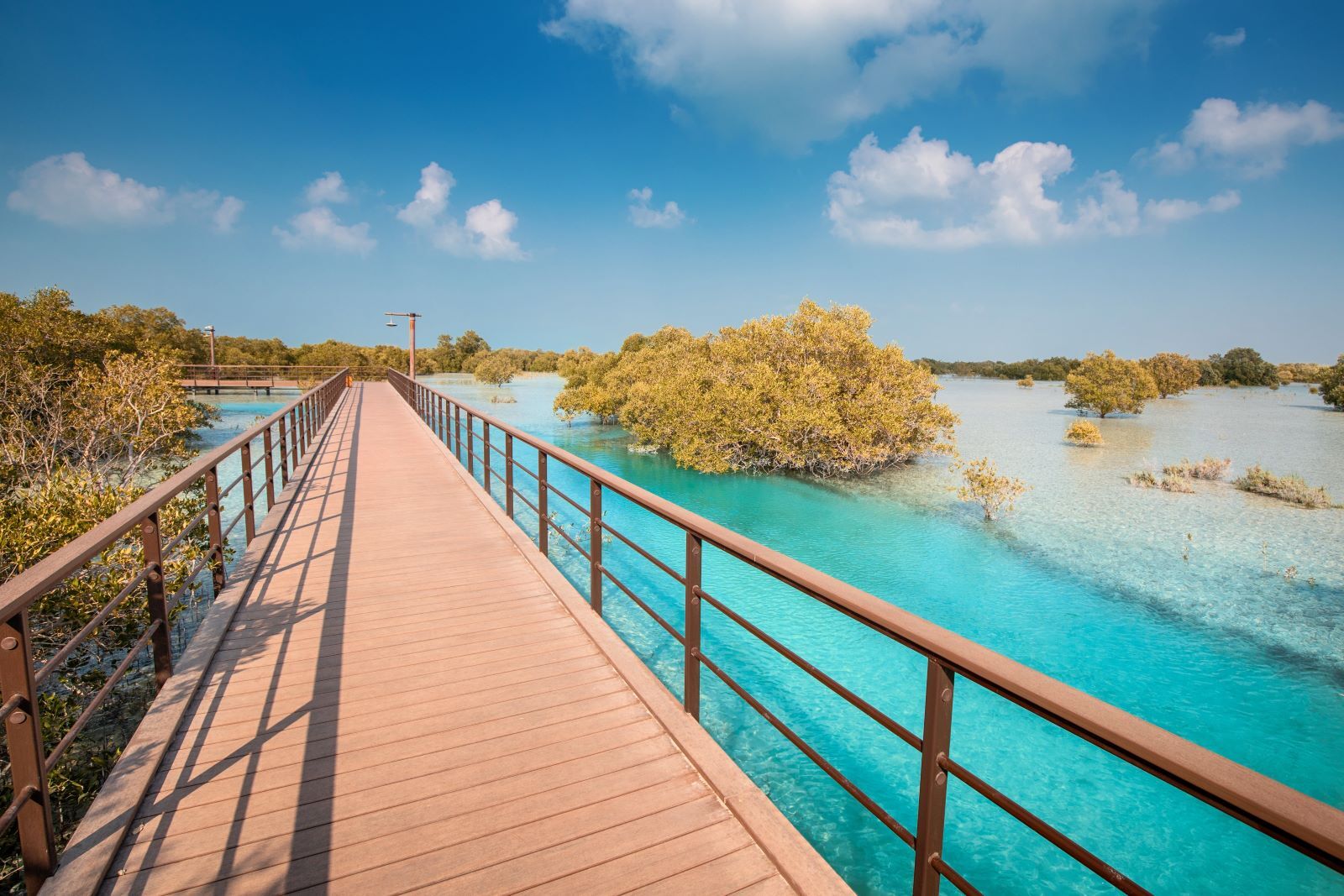
Natural Splendour Amidst the Mangroves
Jubail Mangrove Park is a serene natural cradle of biodiversity, where visitors can witness the captivating ebb and flow of the Gulf’s gentle tides, creating a softly magical experience shaped by water and time. Tucked between Abu Dhabi’s Yas and Saadiyat Islands, yet just a stone’s throw from the gleaming city, this haven feels worlds apart. Spanning approximately 19 square kilometres, Jubail Mangrove Park forms one of Abu Dhabi’s most distinctive natural landscapes and a vital part of the emirate’s broader mangrove ecosystem. A meandering 2-kilometre boardwalk leads visitors over crystal shallows and through stands of silver-leaved mangroves, native to the UAE coastline.
With semi-diurnal tides, turquoise lagoons mirror the sky at high tide, while mangrove roots emerge to breathe at low tide. The landscape is teeming with life: a western reef heron poised at the boardwalk’s edge, schools of fish darting through clear pools, and tiny crabs scurrying amid the roots. Along the route lie an observation deck overlooking a still-water inlet, a floating platform where visitors can peer through netting to observe marine life below, and a rustic viewing tower rising above the treetops, all inviting passers-by to pause and take in their surroundings. Informational signboards, discreetly placed, offer insight into the delicate balance that sustains this remarkable environment.
Conservation and Sustainability Efforts
Over the years, the UAE has developed a stronger sense of ecological responsibility and pledged to plant 100 million mangrove trees by 2030, recognising these coastal forests as vital “green lungs” that will help achieve net-zero goals. Jubail Island itself has taken up this mantle by launching an initiative to plant one million new mangrove saplings, over 500,000 of which have already been planted as of early 2023.
Expanding the mangrove forest not only beautifies the landscape; it actively contributes to climate change mitigation and biodiversity. These mangroves are exceptional carbon sinks, absorbing atmospheric CO₂ far more efficiently than tropical rainforests. They also act as guardians of the coast, buffering shorelines from erosion and storm surges while moderating tidal flows. Within their tangled roots, nurseries for marine life flourish, supporting fish populations and migratory bird species. Together, these functions provide irreplaceable ecological services, from protecting coastal communities to supporting food security. These ecological benefits shaped every aspect of the park’s design.
The park was designed root and branch to minimise its ecological footprint while creating a serene experience for visitors. Boardwalks are raised and crafted from treated timber that blends into the environment, ensuring natural water flows remain undisturbed. Even during construction, workers were trained in habitat sensitivity and eco-engineering techniques were employed to limit impact. Today, the park operates under strict guidelines, with controlled visitor numbers and clear rules to preserve tranquillity for both wildlife and guests.
Engaging Visitors in Conservation
Guests are not just passive observers; they are invited to become participants in conservation. Through “edutainment” programmes and interactive activities, one can plant young mangrove saplings by hand or join guided habitat clean-ups, forging a tangible connection with nature’s work. Standing knee-deep in the mud to plant a sapling, a traveller might feel the poignant thrill of giving back – a small act that will grow for decades. Educational boards and ranger-led tours gently illuminate how these very mangroves mitigate climate change and foster biodiversity. It’s a learning experience as much as a leisure one: families leave with children who now understand how a crab or a mangrove propagule fits into the great web of life. Such efforts have not gone unnoticed. High-level dignitaries and global environmental champions have been drawn to Jubail Mangrove Park – even Britain’s Prince William visited the park during an official engagement. Partnerships with organisations such as Etihad Airways and Emirates NBD further underscore its role in promoting a greener future.
Historical and Cultural Significance
Long before eco-tourism entered the lexicon, the mangroves of this region were quietly weaving themselves into the UAE’s culture. Locally known as Al-Qurm, mangroves have protected the Gulf coast for centuries - a natural bulwark against the whims of the sea and a giver of life in an arid land. These wetlands were historically the only coastal forests linking land and the sea in the UAE. Fishermen knew that within the tangled roots lay nurseries for fish that would later fill their nets, and pearl divers would rest in the cool shade of the mangrove inlets after voyages at sea.
The park’s design pays homage to heritage, the “Salt Collector,” harkens to traditional salt harvesting methods, demonstrating how coastal peoples were attuned to the tides. The “Beach Tower” node allows visitors to touch the tidal waters, evoking the timeless practice of wading into mangroves for crabs or fish. Such elements stitch the past to the present. In Jubail Mangrove Park, the history of a landscape and the culture of a people come alive, grounding the park in both nature and heritage.
Exclusive Yet Purposeful: A Destination for Discerning Travellers
Not for mass tourism by any stretch, Jubail Mangrove Park has carved out a niche as an exclusive, purpose-driven destination. As a curated and intimate experience, the park’s management ensures that only a limited number of guests wander the boardwalk at any given time. Since its opening in 2020, it has nonetheless become one of the most sought-after destinations for nature lovers, drawing well over a hundred thousand visitors.
This is not luxury in the traditional sense – no gilded lobbies or butlers – but rather a boutique experience of nature. The park offers yoga and meditation sessions at dawn, allowing guests to centre themselves in nature’s embrace. For the adventurous, there are guided kayak tours at first light or sunset, where one can silently paddle through emerald channels and witness the park in all its early light. Even fitness takes on a novel twist here – with spinning classes held on a terrace with panoramic mangrove views. Every activity at Jubail Mangrove Park is designed to deepen the connection between the traveller and the environment.
Read More
Recent Articles