Cultural districts are built on coherent planning strategy, so when museums, galleries and learning institutions are brought into proximity, they begin to function as a connected ecosystem, where each venue strengthens the visitor’s understanding of the next. Saadiyat Island reflects that logic and is conceived as a cultural district shaped around the idea that collections and public programming gain depth as they work in tandem. Sprung as one of the world’s cultural hubs, Saadiyat urban planning resonates with Abu Dhabi’s ambition to shape a prominent presence across arts and heritage. The capital has staked a great deal on turning the district’s 27-square-kilometre into a cluster of architecturally iconic, world-class museums and cultural institutions.
In2026, this dialogue is already tangible. Louvre Abu Dhabi has anchored the island since 2017. The Abrahamic Family House has added a thoughtful civic dimension since 2023. Then, in late 2025, three major openings broadened Saadiyat’s remit significantly: Zayed National Museum, Natural History Museum Abu Dhabi, and teamLab Phenomena Abu Dhabi.
Louvre Abu Dhabi
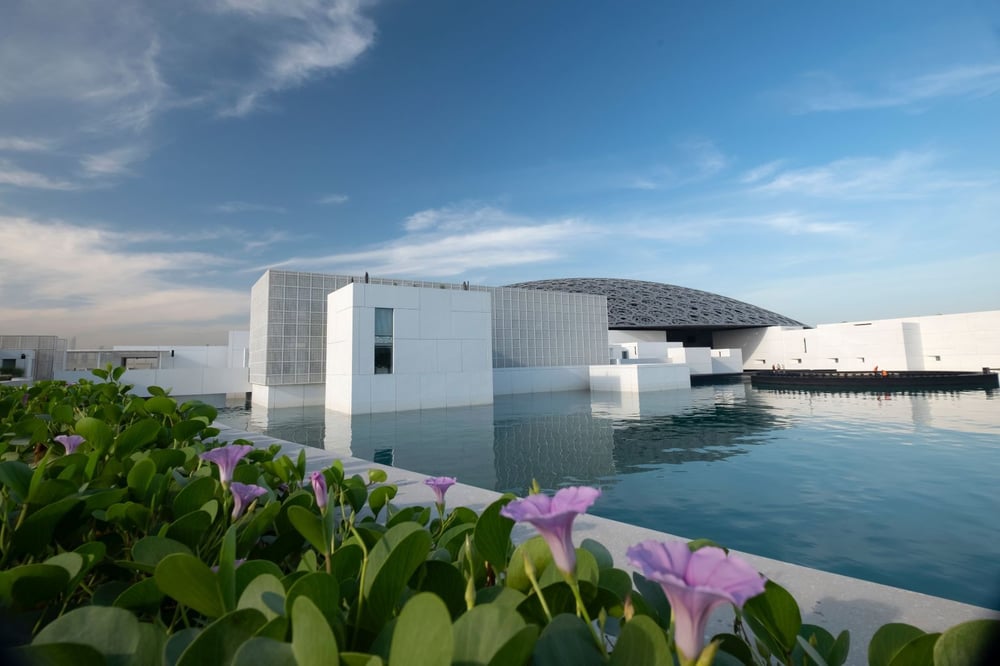
Since its opening in November 2017, Louvre Abu Dhabi has acted as the district’s intellectual cornerstone. A universal museum and cultural centre, it presents art and artefacts from across continents and centuries through a chronological narrative that emphasises shared human themes rather than geography alone. The final setting is deliberately connective: sacred objects, courtly portraits, scientific manuscripts and modern canvases are all placed together to inspire visitors to look beyond the surface-level differences and celebrate what binds human societies across time and space.
Jean Nouvel’s architecture forms a network of white pavilions that sit over water, recalling the logic of an old coastal settlement, while the monumental dome above is a working piece of architecture. Spanning 180 metres and weighing around 7,500 tonnes, it is engineered to read as a floating canopy, carried discreetly on four concealed piers. Its surface, made up of 7,850 stars, forms a set across eight layered screens of metal, calibrated to filter the sun into a shifting, dappled “rain of light”, a clear nod to palm fronds in an oasis. Crucially, the dome shades the outdoor courtyards, supports a comfortable microclimate, and crowns the museum’s medina-like network of low-rise pavilions, turning the journey between galleries into part of the experience.
Zayed National Museum
Zayed National Museum, which opened on 3 December 2025, is dedicated to Sheikh Zayed bin Sultan Al Nahyan, the UAE’s founding father, and is the district’s national anchor – a place where the Emirates’ past is presented with scholarly seriousness and clear public intent. Designed by Foster + Partners, the building is defined by five soaring steel forms that echo falcon wings, rising from a grounded, sand-toned base. The symbolism is direct yet dignified, rooted in Sheikh Zayed’s association with falconry and the desert environment. Acting as thermal chimneys, the wing-like towers support natural ventilation, which is a passive cooling strategy reinforced by air pre-cooled through buried ground pipes.
Rather than a conventional forecourt, Al Masar Garden begins some 600 metres from the entrance, unfolding as an outdoor gallery that guides visitors through three distinct landscapes – desert, oasis and urban – as a quiet primer to the nation’s story. Native planting anchors the route in local ecology, with the ghaf offered as a symbol of endurance, while the falaj introduces sound and logic of oasis life, shifting the atmosphere from coastal openness to a more considered, shaded calm before the atrium is reached. Inside, the museum’s galleries guide visitors through the UAE’s archaeological and cultural foundations, from early settlements and trade routes to maritime life, desert traditions and the formation of the modern federation. For families, the museum offers a lucid, well-paced introduction to national history. For international audiences, it provides an essential context for understanding Abu Dhabi’s modern cultural confidence.
Natural History Museum Abu Dhabi
Opened to the public on 22 November 2025, the Natural History Museum Abu Dhabi extends Saadiyat’s scope beyond art and heritage into the sciences. Its purpose is to narrate the story of the universe and life on Earth, while also grounding that story through the lens of the Arabian region.
Mecanoo, the Dutch practice behind the design, draws directly on geology, with layered, sculptural forms that evoke strata and the slow passage of time. The 35,000-square-metre building reads like a rock formation shaped by desert forces; its massing and texture offer an immediate architectural cue to the museum’s subject matter. Geometry provides a unifying thread throughout, with repeating pentagonal forms that nod to cellular structures and naturally occurring crystal patterns, while water and vegetation are woven into the sequence as quiet symbols of life and resilience.
Conceptually, Mecanoo frames the museum as a formation set along an “urban wadi”, poised between land and sea, and the narrative within mirrors that sense of movement and discovery. The visitor journey is structured across deep time, moving from cosmic origins to the emergence of life, extinction events, and the complexity of contemporary ecosystems.
teamLab Phenomena Abu Dhabi
teamLab Phenomena Abu Dhabi, completed in April 2025, sits within the Saadiyat Cultural District as a multi-sensory art environment of roughly 17,000 square metres. Designed by MZ Architects and teamLab, the project is rooted in the latter’s “Environmental Phenomena” concept, shifting digital art from something merely viewed to an atmosphere that is experienced. Unusually, the design process ran in reverse: interior volumes and installation spaces were planned individually, allowing the exterior to develop the moment the interior programme was embedded. Interestingly, its facade echoes natural phenomena such as winds, dunes, waves and clouds.
The building’s intricate three-dimensional curves demanded precise coordination, supported by computational design and digitally-produced construction drawings. Walking inside, visitors’ eyes fall on a series of pillar-like installations that form a landscape reminiscent of a forest. These are not mere structural supports, but purposeful elements that break sightlines, create depth and curiosity, and discreetly house the technical equipment behind the experience.
Guggenheim Museum
Set to open in 2026, Guggenheim Abu Dhabi crowns the cultural constellation on Saadiyat Island. Designed by the late Pritzker Prize-winning architect Frank Gehry, the building is conceived as a small architectural city – a cluster of irregular volumes and cone-like forms that recall the logic of regional wind towers, using shade, height and air movement to temper the coastal-desert climate. Visitors' experience is expected to unravel as a sequence of courtyards, bridges and gallery volumes, where they will be able to shift between expansive, light-filled halls and more intimate rooms designed for encounters. As a part of the Guggenheim network, the museum‘s programme will centre on modern and contemporary art from the 1960s onwards, framed within a global context while emphasising narratives from West Asia, North Africa and South Asia.
Seeing how far the capital has pushed its cultural agenda, it is hard to imagine the momentum easing. There is a clear thirst for what comes next and eyes are already fixed on what is underway.