

Mangrove National Park: Kayaking Abu Dhabi's Green Coastline
At high tide the channels of Mangrove National Park fill just deep enough for a kayak to pass between the trees. Grey mangroves crowd in from either bank, their lower branches reaching out over the water and their roots pushing up through the mud beneath, and beyond the shallows the city is never far away.
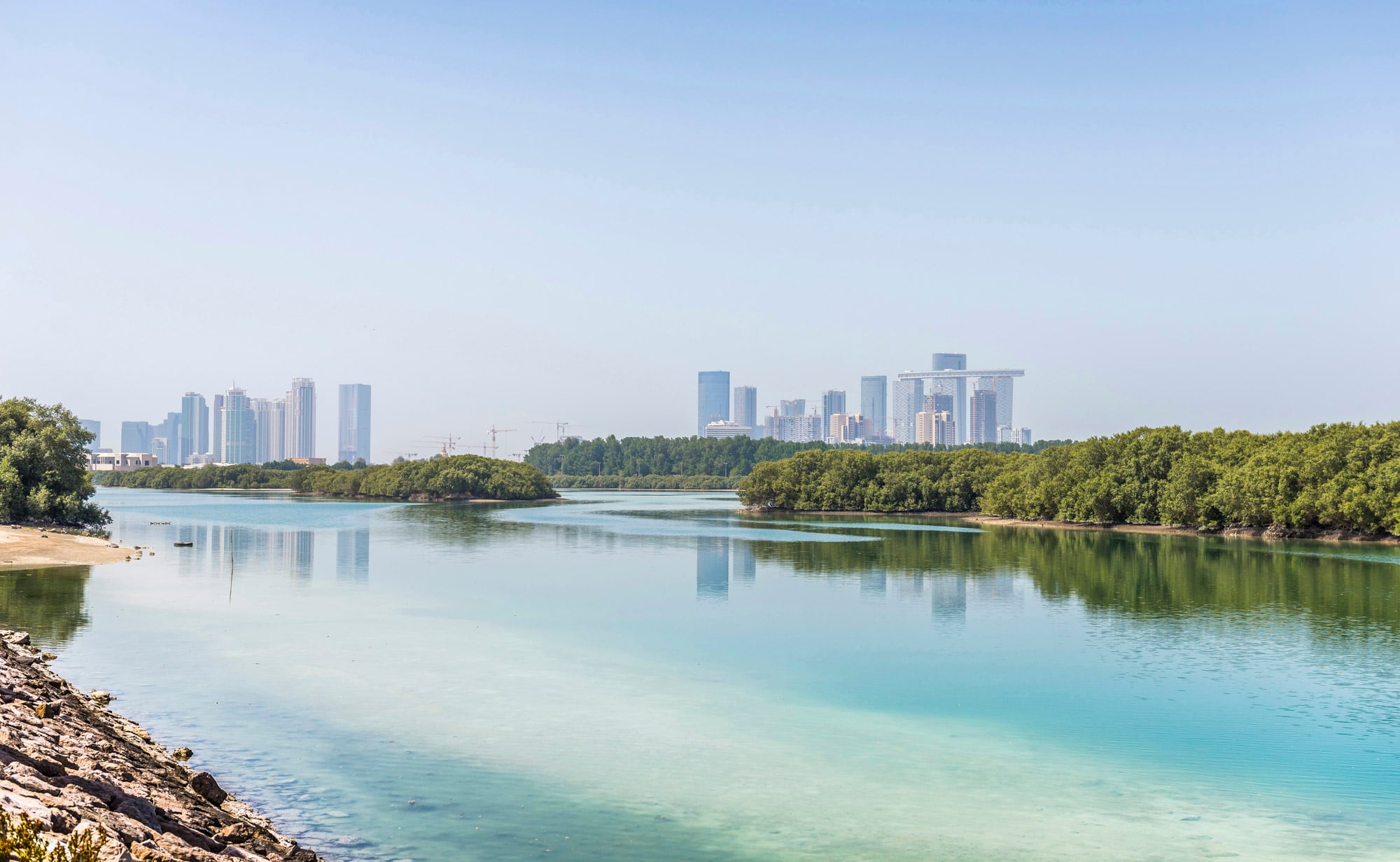
This stretch of shore holds a particular place in the emirate’s environmental history. According to the Environment Agency – Abu Dhabi (EAD), the first mangrove planting project on Abu Dhabi’s coast began in 1966, the year Sheikh Zayed bin Sultan Al Nahyan became Ruler, and it was his own interest in the sea and the shoreline that set it in motion. The plantation at the Eastern Mangroves became the starting point of the emirate’s first mangrove programme, and as planting grew through the 1970s Sheikh Zayed guided it personally, drawing on the knowledge of local people. The forest is now protected as Mangrove National Park, part of the Sheikh Zayed Protected Areas Network and managed by EAD, and it covers more than 19 square kilometres along the Eastern Ring Road.
Into the Channels
Most people explore the park by kayak, although licensed operators also run stand-up paddleboarding and private boat tours, the latter suiting those who would rather watch the birds than paddle. EAD’s own visitor information gives the example of a two-hour kayak tour, and Anantara Eastern Mangroves Abu Dhabi stands on the edge of the park, close enough for its guests to have the forest almost on the doorstep.
Timing matters more than stamina. Visit Abu Dhabi advises going at high tide, when the narrower channels carry enough water to paddle, and suggests a guide for anyone unsure of the route, since navigation can be awkward in some seasons. At lower water the picture changes, as more of the mudflats and the root systems come into view, and the cooler months are the most comfortable for a longer outing.
The birdlife is the main draw for many. EAD records more than 60 species feeding and nesting in the park, among them western reef herons, and greater flamingos visit as well, though their numbers come and go with the seasons. Closer to the roots, mottled crabs work the mud and small fish move between the submerged stems, and Visit Abu Dhabi also lists turtles, dolphins and dugongs among the wildlife of the park and its surrounding waters. Sightings are never guaranteed, admittedly, and a guide who knows the channels will usually spot far more than a newcomer.
Living With Salt
The trees are almost all of one kind. The grey mangrove, Avicennia marina, known locally as qurm, is the only dominant mangrove species in the emirate, and EAD’s survey work puts the average height of mature trees at about five metres. It copes with the warm, saline waters of the Gulf in ways that are easy to see from a kayak. Glands on the leaves excrete surplus salt, which sometimes shows as fine crystals on the surface, while short, pencil-like roots called pneumatophores rise from the mud around each tree and take in air when the tide is out. At low water, they stand exposed in their thousands.
The forest does a good deal for the coast. Juvenile fish use the submerged roots as a nursery before moving out into open water, and the trees help protect the shoreline from flooding, storms and erosion while storing carbon in their wood and in the sediment beneath them. Their timber had older uses too. Poles of mangrove wood, known as chandal, once carried the roofs of traditional Emirati buildings.
Planting for the Long Term
What began in 1966 is now an emirate-wide effort, and its more recent chapters show how much the methods have changed. The Abu Dhabi Mangrove Initiative was launched on 10 February 2022 by His Highness Sheikh Khaled bin Mohamed bin Zayed Al Nahyan, now Crown Prince of Abu Dhabi, and Prince William, now Prince of Wales, during the prince’s visit to the capital, and it brings research and blue carbon projects together under one programme. A year later, EAD announced that it had sown one million mangrove seeds by drone near Al Mirfa in Al Dhafra.
The science has become more careful as well. EAD’s Technical Guidelines for Mangrove Restoration in the UAE, developed with the Ministry of Climate Change and Environment and Emirates Nature–WWF, were the first national publication of their kind, and they include a recommendation that is easy to overlook. Some mudflats are better left as they are, because migratory shorebirds depend on them for feeding and resting, and planting trees there would do more harm than good.
Visitors play a smaller part, but a real one. Keeping a respectful distance from feeding birds, staying on the routes set by the operator and taking care not to strike the exposed roots with a paddle all help to keep the channels as they are.
The Wider Coastline
The forest can also be enjoyed without getting wet. Al Gurm Corniche runs beside the park with a 3.5-kilometre shaded cycle track linking Abu Dhabi Island to the mainland, and of its eight viewing platforms, two give access to the water for kayaking towards the mangroves. It is open around the clock, and the learning platforms, fitted with swings, binoculars and nets slung over the water, make an easy introduction for younger children before a first trip by kayak.
Further along the coast, between Yas and Saadiyat, Jubail Mangrove Park offers a different way in. Opened in 2020, it has a boardwalk of about two kilometres through the trees and guided kayak tours at first light and at sunset. The mangroves there have shaped the community growing up beside them. On Jubail Island, more than half of the land is legally protected, and the new villas have been planned to sit within that setting rather than replace it.
Planning a Visit
Mangrove National Park lies along the Eastern Ring Road, just outside the city centre and close to Al Reem Island. Viewing the mangroves costs nothing, according to EAD, while guided excursions and equipment hire are paid for. Booking through a licensed operator is the sensible course, and it is worth checking the access arrangements, the departure point and the state of the tide before setting off. EAD suggests bringing sunscreen, a sun hat and a reusable water bottle.
The work that Sheikh Zayed set in motion has since been carried along the emirate’s coast, but the Eastern Mangroves, a short drive from the city centre, remain the easiest place to see where the first programme began.
Read More