

Jebel Hafeet: Mountain Escapes Near Abu Dhabi
Its name, according to Abu Dhabi’s tourism authority, translates as “empty mountain”. From the palm groves of Al Ain, the description seems fair. Jebel Hafeet appears as a long, bare ridge of folded rock, rising to 1,249 metres on the border with Oman. It is the highest peak in the emirate of Abu Dhabi and the second highest in the UAE. Look more closely at its lower slopes, however, and the emptiness gives way to more than 500 stone tombs, some of the oldest monuments in the country.
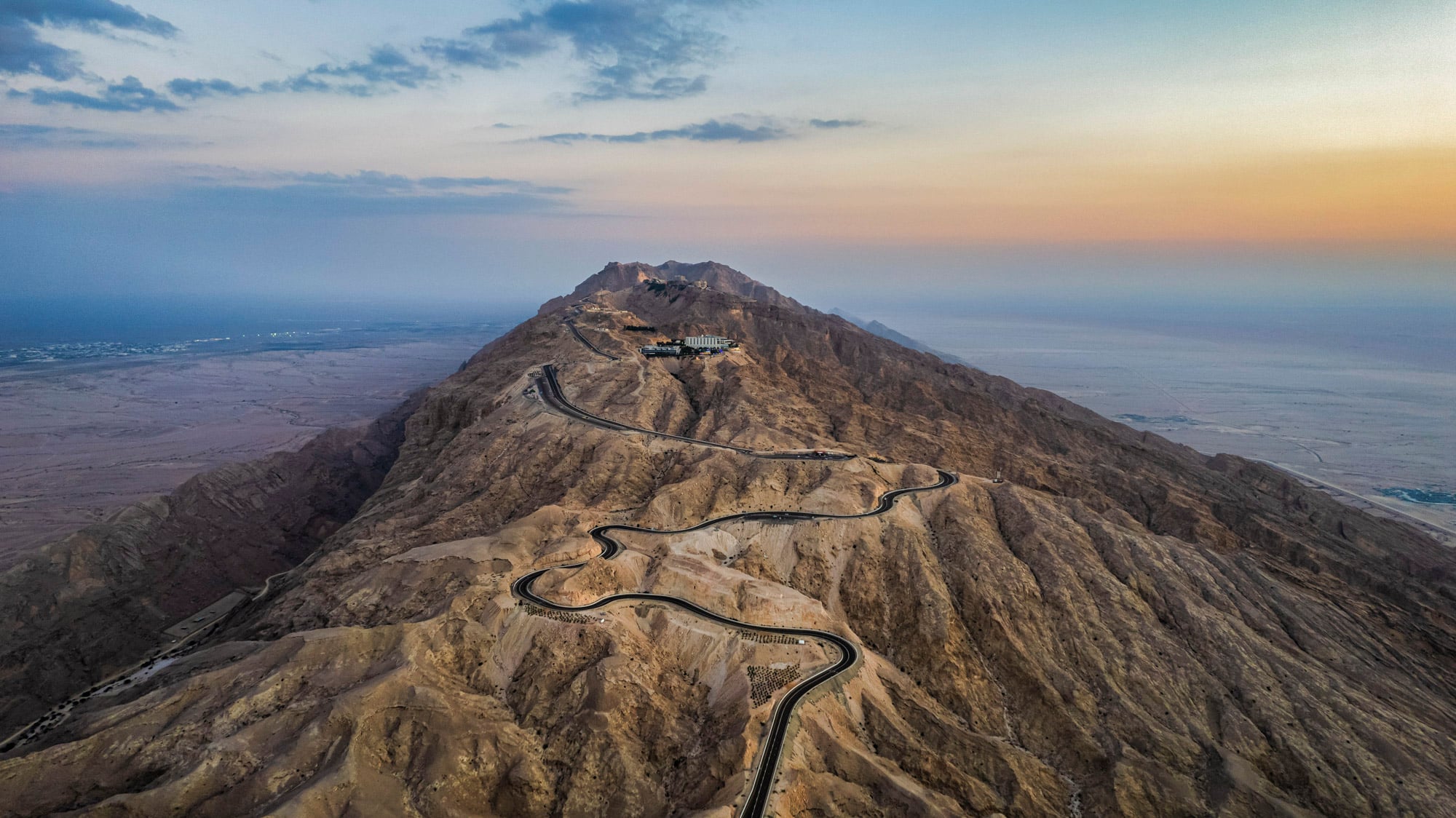
The journey is worth making for that contrast alone. Al Ain, after all, lies about an hour and a half by road from the capital, close enough for a day trip and varied enough to repay a weekend. A visitor can watch the sun rise from the summit, walk among Bronze Age burials by mid-morning and spend the afternoon in a working oasis without covering much ground.
The Road to the Summit
Most visitors arrive by car. A paved road climbs the slopes in a long series of switchbacks, opening view after view across Al Ain and the plains towards Oman. The ascent can also be made by motorbike or, for those with the legs for it, by bicycle.
Visit Abu Dhabi, for its part, recommends the mountain at sunrise and sunset, when the low light picks out the folds of rock and lengthens every shadow on the plain. There is little to be gained by hurrying to the top, and several viewpoints on the way up deserve a stop.
Five Thousand Years Below
The tombs on the lower slopes were built around 5,000 years ago and mark the beginning of the Bronze Age in what is now the UAE. Archaeologists call them beehive tombs, and the name suits them. Each is a small, rounded cairn of rough local stone, enclosing a single chamber that held the remains of perhaps two to five people.
Their history as an object of study is comparatively recent. In 1959, at the request of Sheikh Zayed bin Sultan Al Nahyan, a team of Danish archaeologists began excavating the tombs. Among their finds were ceramic vessels and copper objects, evidence that those buried here belonged to trading networks reaching far beyond Al Ain.
They gain, too, from comparison with what followed. Some centuries later, builders in the region had moved on to the larger, finely dressed Umm an-Nar tombs, which could hold hundreds of burials. Beside them, the Hafeet cairns look almost improvised. Yet they came first, and archaeologists have named an entire era, the Hafit period, after the ridge on which they stand.
On the World Heritage List
Remains such as these help explain why, in June 2011, the Cultural Sites of Al Ain became the UAE’s first entry on the UNESCO World Heritage List, and this summer marked fifteen years since the inscription. The listing joins four areas: the tombs of Hafeet, the archaeological site at Hili, Bidaa Bint Saud and the oases of Al Ain. Hili holds the earliest evidence of an agricultural village in the UAE, dating to around 2500 BC.
UNESCO described the sites as “testimony to ancient sedentary human occupation in a desert region”, and the phrase explains why they belong together. The cairns hold the dead; the oases show how the living managed. Between them, they trace a community learning, over several thousand years, to make a home where water was scarce.
Jebel Hafit Desert Park
For those who would rather see the tombs at close quarters, the simplest approach is through Jebel Hafit Desert Park, which stretches for some nine kilometres along the base of the mountain. It was laid out to protect both the archaeology and the natural setting, and guided hikes lead to the burials themselves. Walkers, mountain bikers, riders and visitors on camel-back share its trails.
Nor is its interest confined to the Bronze Age. Finds here date back to the Neolithic period, some 8,000 years ago, and the rocks themselves show how this corner of Arabia has changed over far longer spans of time. It is, in effect, an open-air introduction to the region’s geology and early history, and it is well suited to families.
Staying the Night
A day will do for the summit. A night allows Jebel Hafeet to be seen at leisure, at dusk and again at first light, without the drive from Abu Dhabi at either end.
The desert park caters for most temperaments. Those who enjoy camping in the traditional sense may bring their own equipment and pitch on a designated site. Others may prefer the serviced Bedouin-style camp, where breakfast is included, or one of the park’s furnished, air-conditioned bubble tents, whose clear walls leave the night sky overhead. On a clear winter night, the stars make the case on their own.
The Oasis Below
From the park, it is a short drive back into town and to Al Ain Oasis, the largest in the city and part of the same World Heritage listing. Its 136 hectares hold more than 147,000 date palms of over a hundred varieties, with mango, orange, fig and jujube, known locally as sidr, growing in their shade. Paths run between the plots, each still farmed and divided from its neighbour by historic walls.
The water arrives much as it has for centuries. The oasis is fed by wells and by the falaj, an ancient system of underground and surface channels that carries water down from the mountains. Two principal channels, Al Aini and Al Dawoodi, each serve a different part of the oasis, and both rise to the south-east, towards the Hajar range. Walk beside them, with the mountain on the skyline, and it is easy to see why the palms grow where they do.
Planning the Journey
As for the season, the cooler months, roughly from October to April, are the most comfortable time for walking and camping, and even then the exposed slopes call for sturdy shoes, plenty of water and protection from the sun. Guided activities and camping places are best confirmed with the park before setting out.
For a single day, one sensible order is to begin in the oasis while the air is still cool, continue to the desert park around midday, and drive the mountain road in the late afternoon, so as to reach the upper viewpoints in time for sunset. With a night in hand, the order can simply be reversed the following morning.
The Empty Mountain
For most visitors, Abu Dhabi is a place of coastline, museums and islands. Jebel Hafeet offers a different picture of the emirate, shaped by the long patience of people who lived inland. The mountain may have earned its name from the bare rock of its upper slopes. Its foothills have rarely been empty at all.