

Forty-Eight Nations, One Trophy: Your Guide to the FIFA World Cup 2026
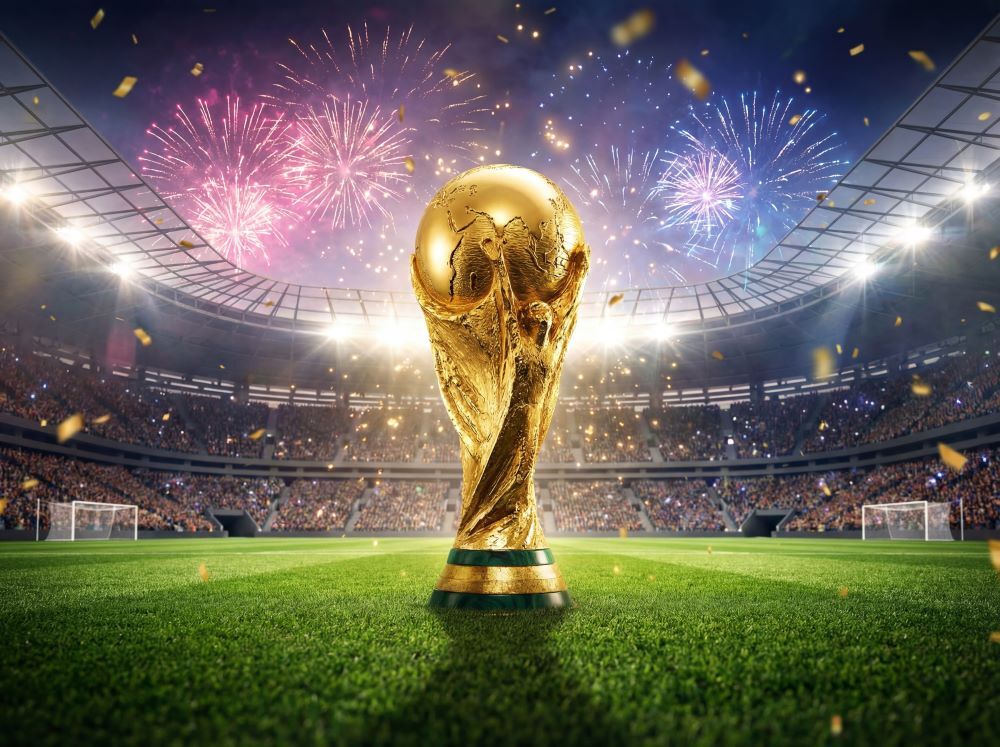
Forty-eight competing nations. One hundred and four matches. Sixteen host cities spread across three countries and five time zones. Thirty-nine days from opening whistle to final. The 2026 FIFA World Cup, which runs from 11 June to 19 July across Canada, Mexico, and the United States, does not merely surpass everything that preceded it, but redefines what a global football tournament can look like.
To appreciate the scale of the expansion, consider what it replaces. Qatar 2022 featured 32 teams and 64 matches compared to the 48 and 104 this year. For the first time in the competition's history, three sovereign nations share hosting duties. For the first time in 32 years, the World Cup returns to North America. And for the first time in the sport's history, a round of 32, placing 32 sides in the knockout bracket, will serve as the entry point to the business end of the tournament.
How the Competition Works
The revised format organises the 48 nations into twelve groups of four rather than the traditional eight. The top two finishers in each group advance automatically; the eight best third-placed teams across all groups join them. It is worth understanding this structure before the group stage begins on 11 June. A team that loses their opening match is not necessarily out of contention; equally, topping the group remains the surest route to a favourable knockout draw.
The Venues
Sixteen cities across North America have been selected as hosts, organised into Western, Central, and Eastern clusters to reduce unnecessary travel during the group stage. The United States provides eleven venues: Atlanta, Boston, Dallas, Houston, Kansas City, Los Angeles, Miami, New York/New Jersey, Philadelphia, the San Francisco Bay Area, and Seattle. Mexico contributes Mexico City, Guadalajara, and Monterrey, while Canada hosts in Toronto and Vancouver.
Among the stadiums, two stand apart for their sheer scale. The Estadio Azteca in Mexico City, with a capacity of at least 87,000, will host the opening fixture on 11 June, becoming the only stadium ever to stage three World Cup opening matches. AT&T Stadium in Arlington, Texas, with a capacity ranging between 80,000 and 105,000, is among the largest covered arenas in the world.
The final takes place on 19 July at MetLife Stadium in the New York/New Jersey area. FIFA has confirmed that the occasion will include a half-time entertainment show drawing from the Super Bowl tradition, with Coldplay among the confirmed performers - a signal, if one were needed, that the scale of ambition extends well beyond the pitch.
The Players and the Storylines
The 2026 World Cup arrives at a moment of extraordinary individual talent and of compelling personal narratives.
Lionel Messi is the inescapable figure. The Argentine captain, now 38 and playing club football at Inter Miami, will set a new record with his sixth World Cup appearance, surpassing his own mark of 26 tournament matches. Most observers regard this as his final campaign. Argentina, the defending champions, are attempting to become the first side to retain the title since Brazil in 1962; it is a formidable ambition made more so by the fact that three of the last four defending champions failed to emerge from the group stage.
The narrative of succession runs alongside Messi's farewell. Kylian Mbappé, now at the peak of his powers, captains France, a squad Messi himself has identified as one of the most dangerous in the field. Spain, regarded as outright favourites ahead of France, England, Brazil, and Argentina, have completed a generational transition that has produced what many regard as the most coherent team in world football. Portugal's Cristiano Ronaldo, in what is expected to be his own World Cup swansong, and Norway's Erling Haaland add further lustre to a field of individual talent rarely matched in the competition's history.
Amid the familiar names, four nations will experience the tournament for the first time: Cape Verde, Curaçao, Jordan, and Uzbekistan. Their presence is a reminder that the World Cup, for all its star power, remains equally a story of nations arriving for the first time and carrying that weight with them.
The last six tournaments have produced six different champions - Brazil (2002), Italy (2006), Spain (2010), Germany (2014), France (2018), and Argentina (2022) - a run of diversity without precedent in the competition's history. Whether 2026 extends that sequence or marks the beginning of a new era of dominance is the central question that will occupy football for the next seven weeks.
The Schedule
- 11 June — Opening match: Mexico vs. South Africa, Estadio Azteca, Mexico City
- 11–30 June — Group stage across all 16 cities
- 4–7 July — Round of 32
- 8–11 July — Round of 16
- 12–15 July — Quarter-finals
- 16–17 July — Semi-finals
- 18 July — Third-place match, Hard Rock Stadium, Miami
- 19 July — The Final, MetLife Stadium, New York/New Jersey
Seven weeks. Forty-eight nations. The greatest football competition ever staged. The only question that remains is how closely you intend to follow it.
Read More
Recent Articles